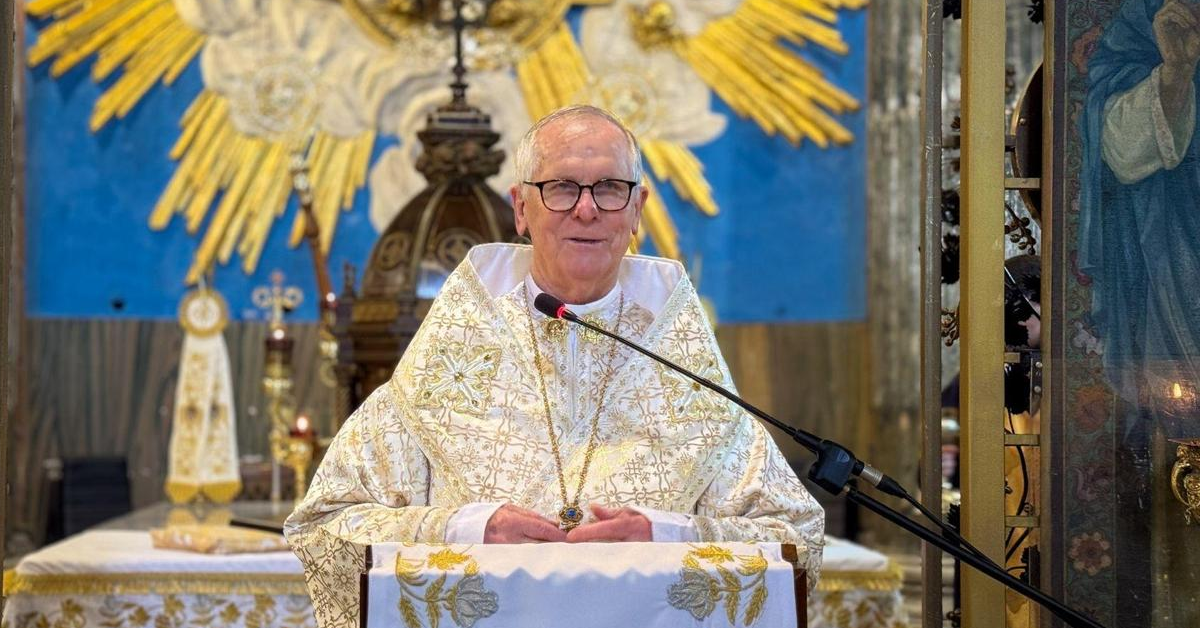
Opening words – Triennial cycle – Bishop Dionysius Paul Lakovich
For Saint Basil, the primary guide to a life of perfection is Holy Scripture. The Longer and Shorter Rules consist of 60 percent quotations from Holy Scripture. Thus, 1,500 quotations from Holy Scripture form the basis of the 55 Longer Rules and 318 Shorter Rules.
Therefore, St. Basil and the Second Vatican Council share the same biblical foundation. We can therefore confidently say that St. Basil is extremely relevant today.
We, who are baptized in the Name of the Holy Trinity, are called to seek God and listen to Him: to read and pray with the Holy Scriptures and to share them with our community.
We, who are gathered in the name of the Father (the source of Love); In the name of Jesus Christ, who revealed the Father’s love as the Way, the Truth, and the Life, so that we may do His work.
In the name of the Holy Spirit, so that as a community of the baptized, we may build community, share our personal gifts; be attentive to the needs of the Church, able to read the signs of the times, and creatively reach out to those in need (see the Basilian Basiliada).
Basilian Asceticism:
To allow oneself to be guided by the Holy Spirit, so that, like Jesus, one may fight against the devil’s temptations.
The devil offers to use one’s gifts to have “bread in abundance,” while asceticism following the example of Jesus means being able to share one’s bread with others, to be the bread of life, to be able to offer one’s body as a sacrifice, to shed one’s blood…
The devil offers power over others, to be first, while asceticism, after the example of Jesus, is to serve, for Jesus did not come to be served, but to serve and to give his life as a ransom for many. “He is the one who serves” (Lk 22, 27).
The devil tempts us to seek our own pleasure and our own will, while Jesus’ asceticism calls us to listen to God and our mentors and to be attentive to the needs of others.
Peter suggests not going to Jerusalem to suffer and die there, whereas Jesus’ asceticism is to go to Jerusalem to fulfill the will of his Father.
On Calvary, the scribes and Pharisees approached him after he had already been crucified, and they tempted him to come down from the cross, even using a very “pious” pretext: “If you are the Son of God, come down from the cross, and we will believe in you” (Mt 27, 42). Yet Jesus’s asceticism lies in his fidelity to the mission entrusted to him by the Heavenly Father until the very end—even when he felt that the Heavenly Father had forsaken him, as he cried out, “My God, my God, why have you forsaken me?”—until he surrendered his spirit into the hands of the Heavenly Father. Faithful to his mission and his consecration to the very end.
Asceticism finds its culmination in the Eucharist: «My body, which is broken; my blood that is shed…» which is fulfilled in the gifts of the Eucharist, in the Eucharistic way of life, when we give others our body to “eat” and our blood to “drink”—precisely when we listen to one another, serve one another, and share our daily bread with one another, giving something of our own to sustain one another’s lives. And then “the Holy Spirit descends upon us and upon the consecrated gifts,” making us one body with the body of Christ. Then we will be resurrected.
I have attempted to offer some general guidelines to assist in the implementation of the three-year program of preparation for the 1,700th anniversary of the birth of our Holy Father Basil the Great and the renewal of the Basilian ideal.
May the Lord’s blessing be upon you, so that the grace of God and the communion of the Holy Spirit, which accompanied our Holy Father Basil the Great, may also descend upon all of us!
Bishop Dionysius Paul Lakovich